The best cities for first-time homebuyers in 2026
First-time homebuyers are stepping into 2026 facing a market that's shifting, but still far from easy.
The end of 2025 saw mortgage rates dip to their lowest level in fourteen months, but they remain elevated by recent historical standards. At the same time, homeowners insurance premiums and property taxes continue to rise nationwide. When you layer in the persistent gap between wages and home prices, affordability remains a central pain point for new buyers, particularly first-timers who typically lack equity and funds for down payments and closing costs.
Still, today's market isn't uniformly bleak. In many mid-sized metros, home prices have stabilized, commutes are manageable, and cost-of-living pressures are far lower than in major coastal hubs. These pockets of opportunity are where first-time buyers can find a realistic path to ownership without sacrificing quality of life.
Neighbors Bank
What Makes a City Great for a First-Time Homebuyer?
A city earns a spot on Neighbors Bank's list by excelling in two areas: affordability and quality of life.
Affordability means that total monthly housing costs (mortgage principal and interest, PMI, property taxes, and homeowners insurance) stay below 35% of the area's median household income. Broader cost-of-living expenses, including utilities, food, transportation, and healthcare were also factored.
To ensure these cities offered perks beyond just the sticker price, quality-of-life factors, including crime rates, unemployment rates, commute times, average childcare costs, home appreciation potential, and entertainment options, were also considered.
Finally, every city on the list has a principal city population of at least 115,000, ensuring access to jobs, amenities, and community.
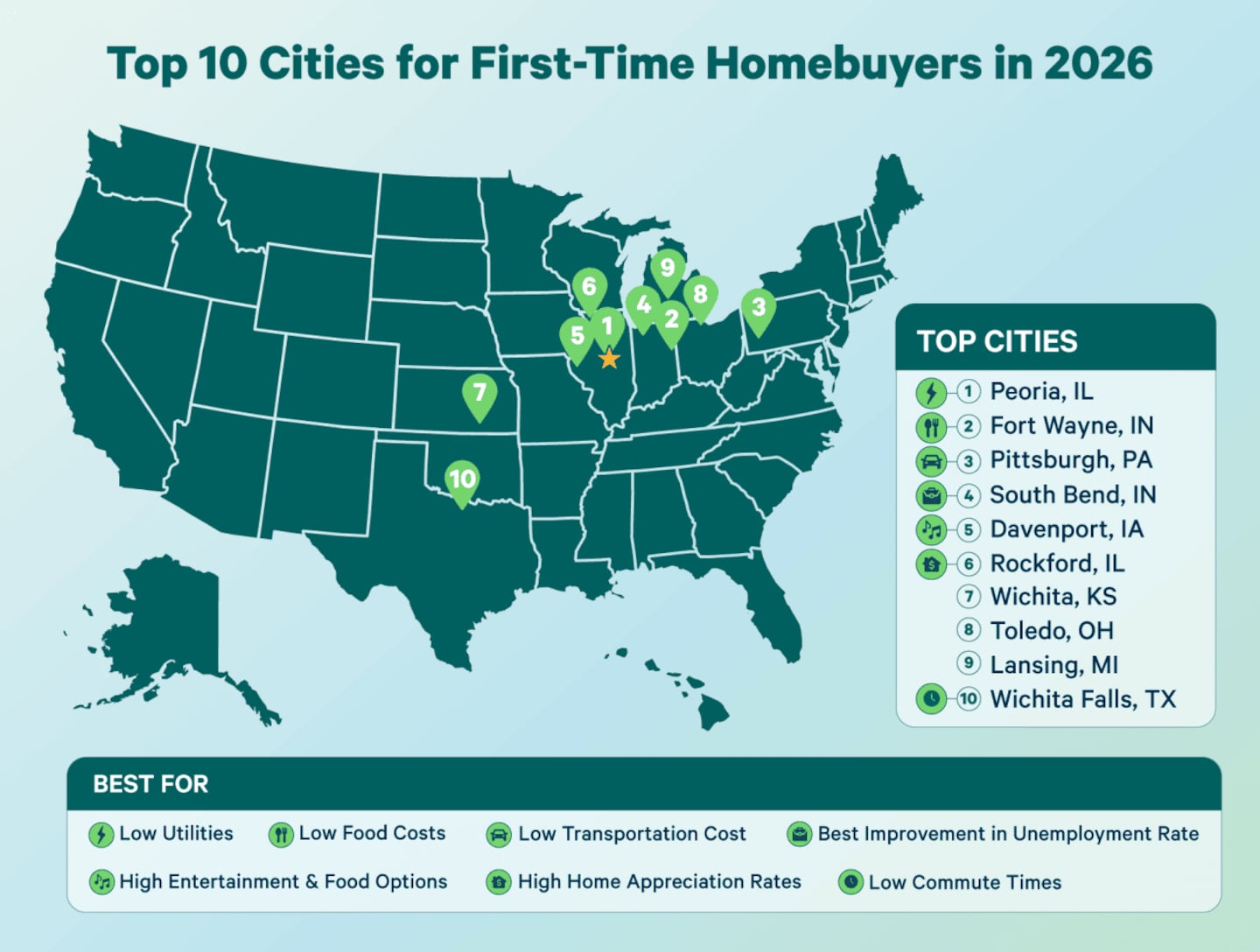
Top 10 Cities for First-Time Homebuyers in 2026
Here are the top 10 cities where first-time buyers can get the most long-term value from their housing dollars in 2026.
1. Peoria, IL
Median Home Price: $161,868
Median Monthly Housing Cost: $1,492
Housing Cost as Percent of Income: 25%
Peoria tops the list by pairing some of the lowest cost-of-living scores with the strongest overall quality-of-life score in the study. Housing costs stay comfortably under the 35% threshold, giving buyers breathing room in their budgets. From 2022 to 2025, home values rose about 18.4%, a sign of solid momentum without runaway price growth. The unemployment rate changed only about +0.1 percentage points between January and August 2025, pointing to a relatively stable job market. Commutes are short for most residents, and childcare costs remain on the more affordable end of the top 10, making Peoria especially appealing for first-time buyers looking to balance day-to-day expenses with long-term stability.
Jobs and Market Snapshot
Peoria's economy is anchored by healthcare, manufacturing, and professional services and major employers include OSF HealthCare, Caterpillar, and UnityPoint Health.
Neighborhoods Worth Knowing
- West Peoria: historic homes, river views, close to downtown.
- Germantown Hills: older homes, parks, convenient access to employers.
- East Bluff: affordable homes near riverfront amenities.
- North Peoria: newer subdivisions, shopping centers, strong schools.
Cultural Hotspots
- Peoria Riverfront Museum
- Civic Center and Theater District
- Warehouse District (restaurants, breweries, art)
Nature Highlights
- Forest Park Nature Center
- Grandview Drive & Park
- Wildlife Prairie Park
- Peoria Riverfront Trail
2. Fort Wayne, IN
Median Home Price: $246,963
Median Monthly Housing Cost: $1,880
Housing Cost as Percent of Income: 33%
Fort Wayne earns the second spot with a strong quality-of-life score and solid housing fundamentals. Monthly ownership costs push closer to the upper end of the affordability range, but buyers get a lot in return. From 2022 to 2025, home values increased about 15.5%, and the unemployment rate improved by roughly 0.3 percentage points between January and August 2025. Combined with relatively low childcare costs, that makes for a solid foundation. Commutes are short, and Fort Wayne's expanding downtown and park systems give first-time buyers a chance to plant roots in a market with long-term upside.
Jobs and Market Snapshot
The local economy is diversified across healthcare, advanced manufacturing, defense, logistics, and financial services. Parkview Health, Lutheran Health Network, General Motors, and Lincoln Financial Group anchor regional employment.
Neighborhoods Worth Knowing
- West Central: historic homes, walkable, near downtown.
- Northside: established neighborhoods and parks.
- Historic Northeast: affordable homes, walkable, with easy access to shops.
- Aboite: suburban-style living with green space.
Cultural Hotspots
- Downtown Arts Campus and Embassy Theatre
- The Landing dining district
- Botanical Conservatory
- Electric Works redevelopment
Nature Highlights
- Promenade Park
- Fort Wayne Trails network
- Headwaters Park
- Fox Island County Park
3. Pittsburgh, PA
Median Home Price: $221,503
Median Monthly Housing Cost: $1,762
Housing Cost as Percent of Income: 29%
Pittsburgh gives first-time buyers access to a large metro at a manageable price point. Housing costs sit just under the 35% threshold, while cost-of-living metrics remain favorable compared to coastal job hubs. From 2022 to 2025, home values rose about 7.6%, reflecting steady appreciation rather than boom-and-bust swings. The unemployment rate edged up only about 0.3 percentage points between January and August 2025, suggesting a fairly resilient labor market.
Major universities, including the University of Pittsburgh and Carnegie Mellon University, drive innovation, medical research, and high-paying jobs.
Pittsburgh's identity also rests on its strong sports culture, with the Steelers, Penguins, and Pirates fostering community and pride. Childcare costs are among the more affordable in the top 10, and the mix of research institutions, sports energy, and revitalized neighborhoods gives buyers a well-rounded urban option with long-term stability.
Jobs and Market Snapshot
Pittsburgh's economy is driven by healthcare, education, finance, and technology. Key employers include UPMC, Allegheny Health Network, the University of Pittsburgh, Carnegie Mellon University, and PNC Financial Services.
Neighborhoods Worth Knowing
- Shadyside: walkable, historic homes, boutiques.
- Lawrenceville: trendy, artsy, renovated rowhomes.
- Squirrel Hill: tree-lined, diverse dining, strong community amenities.
- Regent Square: walkable, great restaurants, tree-lined streets.
Cultural Hotspots
- Pittsburgh Cultural District
- Andy Warhol Museum
- Butler Street dining and nightlife
- Strip District markets and food halls
Nature Highlights
- Point State Park
- Schenley Park
- Frick Park
- Three Rivers Heritage Trail
4. South Bend, IN
Median Home Price: $221,658
Median Monthly Housing Cost: $1,738
Housing Cost as Percent of Income: 32%
South Bend ranks highly as an affordable college town with improving job trends and strong home appreciation growth. From 2022 to 2025, home values increased about 15.3%, giving buyers upside without extreme volatility. The unemployment rate improved by roughly 0.9 percentage points between January and August 2025, one of the better shifts in the top 10. The median housing costs land above some neighbors on the list, but childcare and commute scores fall in the middle of the pack, giving the region a balanced appeal. For buyers seeking a stable job base anchored by a major university ecosystem, this metro offers strong value.
Jobs and Market Snapshot
Top employers include the University of Notre Dame, Beacon Health System, AM General, and manufacturers throughout the South Bend–Elkhart corridor.
Neighborhoods Worth Knowing
- River Park: historic homes located along the St. Joseph River.
- Sunnymede: historic homes, tree-lined, close to downtown.
- Downtown South Bend: walkable with river access, restaurants, and galleries.
- Twyckenham Hills: quiet, family-friendly, with access to parks.
Cultural Hotspots
- Morris Performing Arts Center
- Downtown South Bend
- Notre Dame campus
- Mishawaka event district
Nature Highlights
- East Race Waterway
- Mishawaka Riverwalk
- Rum Village Park
- St. Patrick's County Park
5. Davenport, IA
Median Home Price: $183,689
Median Monthly Housing Cost: $1,680
Housing Cost as Percent of Income: 28%
Davenport offers Mississippi River scenery, paired with a reasonable entry cost for first-time buyers. Housing costs sit well below the 35% threshold, and commute times outperform those of many other metros in the study. From 2022 to 2025, home values rose by about 7.6%, a slower but steady pace compared to some of its peers. The unemployment rate increased by roughly 0.5 percentage points between January and August 2025, reflecting some softening in the labor market. Childcare costs trend higher than the average, but the region remains a stable option, offering riverfront recreation and small-city accessibility.
Jobs and Market Snapshot
Davenport's economy is anchored by manufacturing, defense, logistics, and healthcare. Major employers include John Deere, Rock Island Arsenal, and Genesis Health System.
Neighborhoods Worth Knowing
- McClellan Heights: historic homes, winding streets, hillside charm.
- Village of East Davenport: boutiques, dining, community events.
- Vander Veer Park: classic homes, tree-lined streets, near gardens.
- Hamburg Historic District: vintage architecture, quirky, walkable.
Cultural Hotspots
- Figge Art Museum
- Adler Theatre
- Moline Centre
- Vander Veer Botanical Park
Nature Highlights
- Mississippi Riverfront Trails
- Credit Island Park
- Sylvan Island
- Ben Butterworth Parkway
6. Rockford, IL
Median Home Price: $206,734
Median Monthly Housing Cost: $1,891
Average Housing Cost as Percent of Income: 34%
Rockford takes the sixth spot in the ranking thanks to a strong combination of housing affordability and quality-of-life metrics. From 2022 to 2025, home values climbed about 28.9%, the steepest appreciation in the top 10. Despite this, the median home price in Rockford stayed well under the national median of $360,727. The unemployment rate improved by roughly 0.1 percentage points between January and August 2025, and Rockford stands out for having the best childcare affordability in the top 10. Its share of short commute times also ranks well above average, giving first-time buyers both financial and lifestyle breathing room.
Jobs and Market Snapshot
Rockford's economy is rooted in advanced manufacturing, aerospace, logistics, and healthcare. Key industries include healthcare, aerospace, and advanced manufacturing. Major employers: OSF HealthCare, Mercyhealth, Collins Aerospace, and Woodward.
Neighborhoods Worth Knowing
- Churchill's Grove: historic homes, walkable.
- Edgewater: riverside access, strong community feel.
- Signal Hill: character homes, convenient location.
- Rolling Green: affordability and active neighborhood association.
Cultural Hotspots
- Downtown River Market
- Rockford City Market
- East State Street
- Sinnissippi Riverfront
Nature Highlights
- Anderson Japanese Gardens
- Rock Cut State Park
- Klehm Arboretum
- Sinnissippi Park
7. Wichita, KS
Median Home Price: $214,523
Median Monthly Housing Cost: $1,939
Housing Cost as Percent of Income: 34%
Wichita pairs a relatively low cost of living with one of the stronger quality-of-life scores in the top 10. Housing costs sit high in the affordability range, but buyers benefit from extremely short commutes and a diversified job market anchored by aerospace and healthcare. From 2022 to 2025, home values rose about 13.0%, and the unemployment rate changed only about +0.1 percentage points between January and August 2025, suggesting a generally stable labor picture. Childcare costs fall in the mid-range. Overall, Wichita offers a strong blend of affordability, job access, and outdoor recreation.
Jobs and Market Snapshot
Aerospace, advanced manufacturing, healthcare, agriculture, and energy drive the economy. Spirit AeroSystems and Textron Aviation anchor the aviation sector.
Neighborhoods Worth Knowing
- College Hill: historic homes, dining, parks.
- Riverside: charming homes, parks, museums, and riverside access.
- Maize Proper: family-friendly, top-rated schools, suburban.
- Delano District: walkable, entertainment near downtown.
Cultural Hotspots
- Old Town District
- Museum of World Treasures
- Wichita Art Museum
- INTRUST Bank Arena
Nature Highlights
- Botanica Wichita Gardens
- Arkansas River Path
- Sedgwick County Park
- Chisholm Creek Park
8. Toledo, OH
Median Home Price: $194,680
Median Monthly Housing Cost: $1,605
Housing Cost as Percent of Income: 30%
Toledo offers a balanced mix of affordability and amenities, with monthly housing costs landing well under the 35% threshold. Cost-of-living metrics remain favorable compared to larger Great Lakes cities. From 2022 to 2025, home values increased by about 15%, and the unemployment rate rose by roughly 0.5 percentage points between January and August 2025. Short commutes, strong parks, and an improving downtown make Toledo attractive for first-time buyers seeking value and access to major manufacturing and healthcare employers.
Jobs and Market Snapshot
Toledo's job market is anchored by manufacturing, automotive, healthcare, and materials. Major employers include ProMedica, Owens Corning, and automotive suppliers.
Neighborhoods Worth Knowing
- Old West End: historic homes, arts community.
- Perrysburg: lofts, dining, riverfront events.
- West Toledo: established neighborhoods, schools.
- Point Place: waterfront access and coastal feel.
Cultural Hotspots
- Toledo Museum of Art
- Hensville entertainment district
- Adams Street nightlife
- Riverfront events
Nature Highlights
- Toledo Metroparks
- Oak Openings Preserve
- Wildwood Preserve
- Maumee River and Glass City Metropark
9. Lansing, MI
Median Home Price: $238,495
Median Monthly Housing Cost: $2,000
Housing Cost as Percent of Income: 34%
Lansing stands out for its stable job base and vibrant university-driven environment. Monthly housing costs approach the top of the affordability range, and the cost of living ranks higher than in any other city on the list. In return, buyers access healthy home price growth and strong employment anchors.
From 2022 to 2025, home values rose about 13.8%, and the unemployment rate increased by roughly 0.4 percentage points between January and August 2025. Short commutes and a deep talent pool tied to Michigan State University and the state government offer long-term employment stability and cultural amenities.
Jobs and Market Snapshot
Lansing's economy is driven by state government, higher education, insurance, healthcare, and automotive manufacturing. Major employers include the State of Michigan, Michigan State University, Sparrow Health, Auto-Owners Insurance, and General Motors.
Neighborhoods Worth Knowing
- Downtown Lansing: condos, riverfront living.
- Old Town: arts district, historic character.
- Okemos: walkable suburban center near MSU with a mix of home types.
- REO Town: revitalizing with cafés and creative spaces.
Cultural Hotspots
- Wharton Center for Performing Arts
- Old Town festivals and galleries
- Downtown Lansing dining and breweries
- MSU Museum and arts venues
Nature Highlights
- Lansing River Trail
- Hawk Island Park
- Fenner Nature Center
- Lake Lansing Park
10.Wichita Falls, TX
Median Home Price: $169,458
Median Monthly Housing Cost: $1,666
Housing Cost as Percent of Income: 31%
Wichita Falls offers some of the shortest commute times and lowest living costs in the entire study. Housing costs sit below 35% of income, and day-to-day expenses remain relatively low. From 2022 to 2025, home values rose about 2.8%, a modest pace compared to other metros in the top 10, but that also helps keep entry costs accessible. The unemployment rate held essentially flat between January and August 2025, signaling a steady job market anchored by Sheppard Air Force Base. Buyers drawn to affordability, outdoor recreation, and small-city community life may find Wichita Falls a great fit.
Jobs and Market Snapshot
Wichita Falls' job base centers on military, healthcare, education, and manufacturing. Major employers include Sheppard Air Force Base, United Regional Health Care System, and regional manufacturing and service firms.
Neighborhoods Worth Knowing
- Downtown Wichita Falls: lofts, historic buildings, events.
- Faith Village: established homes, parks.
- Eden Hills: affordable homes, quiet, tree-lined.
- Ninth Street: quiet, residential, close community feel.
Cultural Hotspots
- Depot Square Historic District
- Wichita Theatre Performing Arts Centre
- Kell House Museum
- Arts Council Wichita Falls events
Nature Highlights
- Wichita River Trail and Lucy Park
- Lake Wichita Park
- River Bend Nature Center
- Nearby lakes and prairie landscapes
Methodology
All cities had to have an average housing cost (mortgage principal and interest, PMI, property taxes, and homeowners insurance) that did not exceed 35% of the area's median household income. Neighbors Bank assumed a 30-year mortgage at a rate of 6.25% with a 10% down payment. PMI was estimated at 0.75% of the loan amount.
After these requirements, cities were ranked using a combination of cost-of-living (COL) and quality-of-life (QOL) indices. The most recent reliable data was used whenever possible.
Cost-of-Living Factors:
- Average Utility Cost Per Household By State (2024 to 2025)
- Average Food Cost Using the USDA Low-Cost Plan (2024)
- Average Transportation Cost including Auto Ownership, Auto Use, and Transit Use (2022 to 2023 values, inflated for 2025)
- Average Health Insurance Costs (2024)
- Average Childcare Costs (2022 to 2025)
Cost-of-living factors were normalized and weighted into a composite COL Index.
Average health insurance costs, childcare expenses, transportation costs, and food costs are assumed for a household with two adults and two children (ages 4 and 8).
Quality of Living Factors:
- Change in Unemployment Rate (August 2024 to August 2025)
- Percent of Commutes Under 25 Minutes (2024)
- Median Home Appreciation (October 2022 to October 2025)
- Entertainment and Food Venues Per 10,000 People (2023)
- Reported Violent Crime Per Capita (2024)
- Reported Property Crime Per Capita (2024)
Quality-of-living factors were normalized and weighted into a composite QOL Index.
Population Requirement
- All cities had to have a population of at least 115,000 residents.
Data sources: Zillow, U.S. Census Bureau American Community Survey (ACS) and County Business Patterns (CBP), The Tax Foundation, U.S. Bureau of Labor Statistics, Economic Policy Institute (EPI), Move.org, NerdWallet. Home values as of Oct. 31, 2025.
This story was produced by Neighbors Bank and reviewed and distributed by Stacker.